Search This Blog

Showing posts with label avant-garde. Show all posts

Monday, May 24, 2010

Electronic Music from the University of Illinois

Liner Notes:

The Studio for Experimental Music at the University of Illinois was established in 1958, and placed under the directorship of Lejaren Hiller, Professor of Music, to provide facilities for the creation, research and teaching of electronic music techniques, to investigate the application of computers to musical composition, and to encourage original instrument design and construction. These related roles the studio has fulfilled admirably, and from its relatively modest beginnings it has developed into one of the best equipped in the world.

The works on this recording provide a representative selection of the more than forty works which have been composed in the studio since its inception.

LEJAREN HILLER (b. 1924) came to music by way of science. He has a Ph.D. in chemistry from Princeton University and was a research chemist for some ten years, first with DuPont and later with the Department of Chemistry at the University of Illinois. At Princeton, however, Hiller also studied composition with Milton Babbitt and Roger Sessions, and he later continued his musical studies at the University of Illinois. As a chemist, Hiller became familiar with the use of electronic computers for the solution of scientific problems, which knowledge he subsequently applied to the problem of using computers for musical composition. In 1956, in collaboration with L. M. Isaacson, he composed the "Illiac Suite for String Quartet," using the ILLIAC digital computer of the University of Illinois, and he is the author (with L. M. Isaacson) of Experimental Music, the first book to deal with the problems of computer compositional techniques. In 1958 Professor Hiller joined the faculty of the School of Music at Illinois.

KENNETH GABURO (b. 1926) studied at the Eastman School of Music, the Conservatory of Santa Cecelia in Rome, and the School of Music of the University of Illinois, where he received a D.M.A. degree in composition. In 1959 he was a participant in the Princeton University Seminar in Advanced Musical Studies. He has also been the recipient of a Fulbright grant, a UNESCO creative fellowship, and commissions from the Fromm and Koussevitsky Music Foundations. His Compositions include a series of Antiphonies for live performers and tape, two operas, and works for chamber ensembles, orchestra, and the theatre. Previously recorded works are "Line Studies," "Two," "Three Dedications to Lorca," and "Stray Birds." The earlier of the two works on this recording—"Lemon Drops" (1965)—was composed entirely on the Harmonic Tone Generator developed by James Beauchamp, of the faculty of Electrical Engineering at the University of Illinois. The later work—"For Harry" (1966)—was composed for Harry Partch.

CHARLES HAMM (b. 1925), composer and musicologist, studied at the University of Virginia and at Princeton University. His teachers in composition were Randall Thompson, Bohuslav Martinu, and Edward Cone. Prior to his appointment, in 1963, as Professor of Music at the University of Illinois, he taught at the Cincinnati Conservatory of Music and at Newcomb College, Tulane University. His compositions include six operas, an orchestral work—"Sinfonia 1954"—which was commissioned by the Cincinnati Symphony, and numerous chamber, piano, and vocal works. Among his more recent works are "Mobile for Piano and Tape," "Portrait of John Cage" for piano and three tape recorders, and "Round" for unspecified instrumental or vocal ensemble.

CANTO

For the seven lakes, and by no man these verses:
Rain; empty river; a voyage,
Fire from frozen cloud, heavy rain in the twilight
Under the cabin roof was one lantern.
The reeds are heavy; bent;
and the bamboos speak as if weeping.

Autumn moon; hills rise about lakes
against sunset
Evening is like a curtain of cloud,
a blurr above ripples; and through it
sharp long spikes of the cinnamon,
a cold tune amid reeds.
Behind hill the monk's bell
borne on the wind.
Sail passed here in April; may return in October
Boat fades in silver; slowly;
Sun blaze alone on the river.

Where wine flag catches the sunset
Sparse chimneys smoke in the cross light
Comes then snow scur on the river
And a world is covered with jade
Small boat floats like a lanthorn,
The flowing water clots as with cold.
And at San Yin they are a people of Leisure.

Wild geese swoop to the sand-bar,
Clouds gather about the hole of the window
Broad water; geese line out with the autumn
Rooks clatter over the fishermen's lanthorns,
A light moves on the north sky line;
where the young boys prod stones for shrimp.
In seventeen hundred came Tsing to these hill lakes.
A light moves on the south sky line.

State by creating riches shd. thereby get into debt?
This is infamy; this is Geryon.
This canal goes still to TenShi
though the old king built it for pleasure

K  E I   M  E N  RAN    K  E I
K  I U  M  A N  MAN   K  E I
JITSU  GETSU  K   O   K W A
T A N   FUKU  TAN    K A I

Sun up; work
sundown; to rest
dig well and drink of the water
dig field; eat of the grain
Imperial power is? and to us what is it?

The fourth; the dimension of stillness.
And the power over wild beasts.

("Canto XLIX" Copyright 1948 by Ezra Pound. Used with permission of the publisher, New Directions Publishing Corp.)

HERBERT BRÜN was born in 1918 in Berlin, Germany. As a pupil at the Jerusalem Conservatory of Music in Israel, he studied composition with Stefan Wolpe. Further study has included work at Columbia University, New York, and at the electronic studios in Paris, Cologne, and Munich. A partial list of his compositions includes: "Mobile for Orchestra," "Sonoriferous Loops," "Gestures for Eleven," "Non Sequitur VI," "Gesto for Piccolo Flute and Piano," "Trio for Flute, Double-Bass, Percussion," "Trio for Trumpet, Trombone, Percussion," 3 String Quartets, and numerous scores for the theatre. Since 1955 he has given many lectures and seminars dealing with the function of music in society. He came to the School of Music of the University of Illinois in 1963, primarily to do research on the significance of computer systems for the composition of music, and is presently a member of the faculty there.

FUTILITY 1964

If you were
not yet to understand
the meaning which was conveyed
to these events of sound
it would be understandable

for it is believable
that you do not yet believe
in hearing the sound of events
as they call on you
to create the suitable language
which might let you say to yourself
that which is said to you
just once and never again
for the first and the last time

there is no second time
since a language gained
is a language lost

And to even try
to tell you this
seems a sheer waste of time
for it is language
and thus lost

-Herbert Brün

SALVATORE MARTIRANO (b. 1927) studied composition with Herbert Elwell, Bernard Rogers, and Luigi Dallapiccola. He has been the recipient of many grants and awards for musical composition ("Underworld" was commissioned by the Fromm Music Foundation), and is currently an Assistant Professor of Music at the University of Illinois. His works include the "Chansons Innocentes" for soprano (a setting of texts by e. e. cummings), an a cappella Mass (Sal M's Solemn Psalm), and "O, O, O, O, That Shakespeherian Rag" for mixed chorus and instrumental ensemble.

Notes by R. B. MacDonald

Track List & Credits:
  1. MACHINE MUSIC Lejaren A. Hiller (1964) for piano, percussion and tape. Phyllis Rappeport, piano; Thomas Siwe, pecussion
  2. LEMON DROPS Kenneth Gaburo (1965) (Tape Alone)
  3. FOR HARRY Kenneth Gaburo (1966) (Tape Alone)
  4. CANTO Charles Hamm (1963) for soprano, speaker & chamber ensemble. Helen Hamm, soprano; Elizabeth Hiller, speaker, The Contemporary Chamber Players of the University of Illinois; Jack McKenzie, conductor
  5. FUTILITY (1964) Herbert Brün for speaker and tape, Marianne Bran, speaker
  6. UNDERWORLD Salvatore Martirano (1965) The Contemporary Chamber Players of the University of Illinois, David Gilbert, conductor
Director of Engineering: Val Valentin

Download Links: Enjoy the Music, or here.

Other recordings featuring composers on this recording:
Lejaren A. Hiller
Kenneth Gaburo
Salvatore Martirano

Friday, May 14, 2010

Naked City - Live in Carré 2003

"Naked City was an avant-garde music group led by saxophonist and composer John Zorn. Active primarily in New York City from 1988 to 1993, Naked City was initiated by Zorn as a 'composition workshop' to test the limits of composition (and improvisation) in a traditional rock band lineup. Their music incorporated recognizable elements of jazz, surf, classical, heavy metal, grindcore, country music, punk rock and other genres.

"Zorn discontinued Naked City after Absinthe when he felt '... the need to write music for other ensembles, in other contexts, with new ideas.' A brief reunion occurred in 2003 for a few shows at European jazz festivals."—Wikipedia

The recording presented here is a bootleg from the Holland Festival, Carré Theatre, Amsterdam June 17, 2003. Some of the tracks are extremely challenging and very avant-garde.

Credits:
  • John Zorn - saxophone, vocals, composer
  • Bill Frisell - guitar
  • Fred Frith - bass guitar
  • Wayne Horvitz - synthesizer, piano
  • Joey Baron - drums
  • Mike Patton - Vocals
Track List:
  1. Batman
  2. Latin Quarter
  3. The James Bond Theme
  4. You Will Be Shot
  5. A Shot in the Dark
  6. Snagglepuss
  7. Sunset Surfer
  8. Blood is Thin
  9. Trash Jazz Assassin
  10. Ujaku
  11. Blood Duster
  12. N.Y. Flat Top Box
  13. Demon Sanctuary
  14. Numbskull
  15. Hammerhead
  16. Igneous Ejaculation
  17. Perfume of A Critics Burning Flesh
  18. The Sicilian Clan
  19. Saigon Pickup
  20. Lonely Woman
  21. Body Heat
  22. The Man form U.N.C.L.E.
  23. Tekufah
  24. Osaka Bondage
  25. Shangkuan Ling-Feng
  26. Dead Spot
  27. Blunt Instrument
  28. Speedball
  29. Piledriver
  30. Slan
  31. Gob of Spit
  32. Bonehead
Download Links: full album.

Thursday, May 13, 2010

Kroumata Percussion Ensemble & Friends - Live in Stockholm (1987)

Liner Notes:

EDGAR VARÈSE (1885-1965)

Edgar Varese was born in Paris in 1885. He studied with d'indy, Roussel and Widor—romantic composers whose names hardly indicate the significance Varese would have for the truly new music. But this development did not begin until he was in his thirties, and settled in New York. It is said that the music rack on his piano expanded to become a drafting board, with diagrams and drawings. Although there was a metronome on his desk, the dominating objects were more likely to be the sort of thing to be found in an engineer's office. Two paintings by Miró hung on the wall of his study. He was thought to be working in technical research, and neither his friendly attitude nor his good-naturedness revealed that he was the revolutionary figure of the new music.

And perhaps he wasn't! He said himself that he was only following the path that he found natural. "I do not write experimental music. My experiment is done before I make the music. Afterwards it is the listener who must experiment." In any case, the music he introduced was like nothing else. Each new work, and there were not many, opened the door to a well-planned universe.

Ionisation was begun in 1929 and finally dated November 13. 1931. An ensemble of 13 musicians utilize a total of 37 percussion instruments, including two sirens, glockenspiel, celesta and piano. The three latter instruments are the only ones that can produce specific notes and they are all saved until the final apotheosis of bells. The instruments are divided into different sound groups. All of them cover the register from base to treble, and each part of the work has its own instrumental combination. Rhythm and timbre are the main elements of the composition, and every significant change in timbre also brings about a change in form. Varese has not only wanted to display his pioneering discoveries, he has also made these a part of his artistic means of expression to such a great extent that the music develops organically from the first beat to the last. For half a century, Ionisation has had the ability to capture the listener. The work is one of the founding masterpieces of our time—legendary and style-forming.

SVEN-DAVID SANDSTRÖM (1942)

Sandström was born in 1942 in Borensberg. He studied art history, musicology and, later, composition with Ingvar Lidholm at the State Academy of Music in Stockholm, he also studied with György Ligeti and Per Nörgaard. He was Lidholm's assistant at the composition class until 1974, after which time he has worked as a composer.

For a short time he was a teacher in improvisation at the National College of Music Drama in Stockholm, and since 1981 he has been a teacher of composition and improvisation at the State Academy of Music in Stockholm. In 1986 he was appointed professor of composition there. Among the awards that he has received are the Christ Johnson Music Fund Prize (1974) and the Nordic Council Prize (1984).
Sven-David Sandström has made the following comment on his new work, "Chained":

"The piece was composed especially for this occasion, when a large group of percussionists and pianists were to appear together in an unusual concert performance. The 'chaining' of the title is to be considered in purely musical and rhythmical terms, and it has no ideological or other connection. The title referes to a sort of musical linking in which the complex structure is forced into a locked rhythm. That is the basic ideal. Then suddenly a door opens upon something bright and positive. In the beginning the pianos have lyrical sections, but they are gradually forced into the rhythmic circles of the percussion. By the end of the 25-minute piece they are all working together, with respect to both rhythm and ideas. The low-frequency percussion instruments are placed in the center of a semi-circle containing the remaining percussionists. The rhythms and figures spread like waves through the group in a perceivable yet irregular pattern. The piece is not an experiment. The pianos form a lyrical pole to the rhythmic percussion. The treatment of the pianos is decidely virtuoso. The music is clearly extrovert—music to be experienced. It is not 'easy listening', but has lots of action."

GEORGE ANTHEIL (1900-1959)

Before George Antheil was 25 years old. he was internationally known as the most radical representative of American music. At his death he had written not only six symphonies, three operas, several ballets, orchestral works, and piano and chamber music with time his music became more and more conservative), but he had also edited a column for the lovelorn, invented and patented a submarine torpedo, and had been made an honorable member of the Paris police force after his studies of gland disturbances in criminals.

At the age of 22 he began a European tour. His program included Bach, Beethoven and Chopin—but also his own shocking piano works, Airplane Sonata, Death of the Machines, Sonata Sauvage and Mechanisms, which revealed his futuristic ideas, mechanical rhythms, rich harmonies, violent dynamics and experimental form. These ideas were to be developed and attain their completion in Ballet mécanique.

When he arrived in Paris in 1923, he was hailed as the leading modern composer. The highlight of his stay was the premiere of a ballet which was originally called Message to Mars and was intended loran abstract film by his friend Fernand Léger. The performance in 1925, like that at Carnegie Hall in 1927, was a magnificent scandal. Under the name of Ballet mécanique it became one of those works which are constantly being talked about, but rarely performed.

Later in life, the composer wrote this about his ballet: To those who might wish to understand the intentions and aestetics of Ballet mécanique from my point of view, the most important thing I think I can say about it is that it is somewhat like modern architecture . . . like a modern house, or skyscraper in which ... materials for surfacing, building, are used which had previously never been used before. . .Ballet mécanique is an approach to a new aestetic in music. If one has in mind to understand it, let him listen with new ears, as he must look at a piece of modern architecture with new eyes. Rhythmically, aestetically, materially and constructively it is, I feel, aligned with our modern life. When one considers when it was written—1924—I believe it may also have a bit of prophecy in its pages."

Stig Jacobsson

ANDERS LOGUIN (1954-)

Loguin was educated at the College of Music in Stockholm, taking the percussion soloist course.
He has also had orchestral training in Sweden and England, and has studied conducting in the United States. He has worked as a percussionist with the Stockholm Philharmonic, the Swedish Radio Symphony Orchestra, and the Oslo Philharmonic. He is a lecturer and the head teacher of percussion at the College of Music in Stockholm. Anders Loguin has been a member of Kroumata since it was formed in 1978, and has participated in a number of recordings for radio, television and gramophone, both as a solo and chamber musician, and as an orchestra member. He has conducted the Uppsala Chamber Orchestra, the Stockholm Wind Symphony, various ensembles at the College of Music, and a number of Kroumata productions.

KROUMATA

"THE WORLD'S BEST PERCUSSIONISTS!" was the San Francisco Chronicle's enthusiastic verdict after hearing Kroumata. And the remarkable fact is that these five Stockholm percussion players are taking the world by storm. First Europe and the USA, and now Japan, where Kroumata will be performing in November (1987) together with Keiko Abe, one of the world's finest marimba players.

Kroumata was formed in 1978 for the purpose of presenting percussion music in the form of chamber music and solo playing, but also with the intention of collaborating with other musicians, singers, dancers and soon. Among other things, this has resulted in exciting and variable concert programmes and has encouraged Scandinavian and international composers to write new works expressly for Kroumata. The group has been able since 1981 to work full time, with the Regional Music organisation as its employer—a unique arrangement, not only for Scandinavia but internationally as well. Kroumata has made two LPs, the first of which was awarded the 1984 Swedish Phonogram Prize. The following year the newspaper Expressen nominated the group for its Spelmannen music award. In February this year (1987) Kroumata toured East Germany, and was awarded the Critics' Prize for its performance at the Music Biennial in Berlin.

Credits:
  • THE PIANISTS from left): Richard Pilat, Roland Pöntinen, Carl-Axel Dominique, (cond./dir.:) Anders Loguin, Staffan Scheja. (Foto: Claes Jansson).
  • THE KROUMATA PERCUSSION ENSEMBLE from left): Leif Karlsson, Ian Hellgren, Anders Holdar, Ingvar Hallgren, Anders Loguin. (Foto: Per B. Adolphson).
Track List:
  1. Edgard Varèse: Ionisation
  2. Sven-David Sandström: Chained
  3. George Antheil: Ballet Mécanique
Download Links: Enjoy the Music!, or here.

Other recordings with the Kroumata Percussion Ensemble:

Sunday, May 9, 2010

Wind & Percussion Music by Penderecki, Mayuzumi & Badings

Only one other recording of these works grouped together appears to exist. Performed by the New Brass Symphony, it too is out of print. Even individually these works are tough to find. All three are extremely challenging to perform, and certainly challenging to listen to as well. They display the chaotic complexity of 20th century avant-garde classical style, making them less accessible to general listeners. All three have sections I find particularly nice, but the Mayuzumi is the most accessible work of the three.

Liner Notes:

American Wind Symphony Orchestra
Robert Austin Boudreau, Music Director

A short walk from teeming, downtown Pittsburgh two rivers—the Allegheny and the Monongahela—mingle their waters to form a third, the mighty Ohio, and start it down its 963-mile journey, southwest to the Mississippi. At the point where the rivers meet (to form what looks like the letter Y lying on its side) there is a lovely uncluttered park that attracts many strollers during the warm months. Some come merely to picnic or loaf and watch the boats go by, but many more head for a big red barge anchored on the north (Allegheny) side of the park, the home of a remarkable cultural phenomenon known as the American Wind Symphony Orchestra.

Founded in 1957 by Robert Austin Boudreau, this group of TK musicians, chosen from the top young talent from the United States and abroad, has in its 13-year existence caused a major upheaval in musical circles, not only in Pittsburgh but wherever it has been heard. While most large cities offer some kind of outdoor music in the summer, most of it is of the light-classic or familiar-masterpiece category. Not so, the orchestra in Pittsburgh. It throws in a few toe-tappers for encores now and then ("Down by the Riverside" is the inevitable, if only semi-official, theme), but its major business is the expansion of the musical repertory by commissioning hard, new compositions from some of the most adventurous composers in the avant-garde firmament. What you will hear on this record, is an example of what the American Wind Symphony Orchestra offers its audiences—wildly enthusiastic, please note—on any given night during its eight-week season.

Credit for this unique idea—which can be defined as a refusal to believe that people have to stop thinking once the warm weather begins—must fall to Boudreau, a New Englander trained at Juilliard and the Paris Conservatory, a man fiercely dedicated to preserving culture as a living, growing part of human experience, and awesomely endowed with the twin virtues needed to make one's way in his chosen field these days: the ability to make music superbly and the ability to charm enough money out of private and official sources to keep the enterprise afloat. Credit must also go in large measure to Point Park College in Pittsburgh and its president, Arthur M. Blum, a dynamic educational force in Pittsburgh which maintains the orchestra as part of its growing cultural service to its community.

Pittsburgh is, however, only one of many cities which benefits from the remarkable work of the American Wind Symphony. After the home season each summer, the barge sets out down the Ohio River, serenading communities in six states with the same challenging fare it performs at home. The orchestra's journeys in its time have taken it up and down the Mississippi, through the Tennessee Valley, and the Inland Waterways. Wherever it has sailed on its floating stage, it has spread the excitement of the living, growing musical repertory.

The three compositions presented herewith are splendid examples of the powerful, original music the American Wind Symphony has caused to exist through its commissioning and publishing activities. Each of the three composers—the Dutchman Henk Badings (1907- ), Poland's Krzysztof Penderecki (1933- ) and Japan's Toshiro Mayuzumi (1929- ) is among the most talented and respected free spirits among today's composers. Each of them has approached the problem of writing for a specialized ensemble of winds, brass and percussion with no condescension to the youth of the orchestra's members or the supposed tastes of audiences at outdoor summer concerts. They have, instead, written big, daring, vivid (and extraordinarily difficult) music.

Badings, one of the first major composers to experiment with the fascinating and seemingly limitless possibilities of music produced by electronic means, has created in his Armageddon a harrowing tone-picture of the Last Judgment. His score is in seven sections, of which the first and third are for tape alone. The fifth uses a soprano, who intones a wordless line. The last is a huge climactic section in which tape, orchestra and soprano (this time singing part of the text from the "Dies Irae" section of the traditional Requiem Mass) join forces. "The end of the world," Badings writes of his score, "is not the most attractive theme to linger with in our thoughts. I reread the Bible, I looked again at the woodcuts on the subject by the famous medieval Albrecht Dürer and at the impressive lithographs by Odilon Redon. From them the subject haunted me and I started my sound-fantasies." Badings has included in his score such unusual instruments as a bass flute, a bass oboe or heckelphone and two contrabass-clarinets. His tape was composed with sounds produced by a variety of oscillators, tone generators and ring modulators, transformed by means of an array of sophisticated techniques involving splicing and rerecording to produce the two-track tape heard here.
—Carole Farley, Soprano Soloist

Penderecki's Pittsburgh Overture uses nothing but "live" sounds, but uses them in an even more staggering array. No fewer than 18 types of percussion are required (five woodblocks of varying sizes, six cymbals, six timpani, etc.) along with a full complement of winds and brass. Yet, in no bar of the 104 the work takes are all instruments heard together. Instead, there is a constant vibration, a moving back and forth from one block of sound to the next. Penderecki's style is like that of no other composer active today. Wisps of sound, blurs of sonority sliding up and down the tonal spectrum, blat out at each other, often separated by long, mysterious silences. It sounds at first fragmented, formless; yet, further hearings reveal a subtle but clear over-all structure, a logic involving statement, departure and return that gives the music both shape and substance. Is there a more difficut piece of music in existence? Or an ensemble better equipped to cope with its intricacies? Very likely, not.
 
Mayuzumi, widely known to American audiences through his superb score for John Huston's film, The Bible, is one of the small but remarkable group of Japanese musical iconoclasts that has developed in recent years and brought that distant land into the musical mainstream. His Percussion Concerto, a one-movement work demanding yeoman work from two timpani players and four other percussionists, again along with a large wind and brass ensemble,- is in a single movement that, like the Penderecki Overture, returns to a restatement of its opening material at the end. Like several other avant-garde composers of the day, Mayuzumi has created his music with an ingenious consideration for the actual space that surrounds a performance. The two timpanists, for example, often echo each other's work from opposite sides of the stage, creating a spatial effect exciting in actual performance and also on a stereophonic recording. Vivid, slashing in its rhythms, colorful in its myriad sound combinations, the Concerto stands as almost an encyclopedia of modern percussive effects . . . but an encyclopedia that exists as a living work of art.
—Alan Rich, Music Critic, New York Magazine

Track List:
  1. Krzysztof Penderecki: Pittsburgh Overture
  2. Toshiro Mayuzumi: Concerto for Percussion and Winds
  3. Henk Badings: Armageddon
Download Link: Enjoy the Music!, or here.

Friday, May 7, 2010

Mirage: Avant-Garde and Third-Stream Jazz (1977)

Excerpt from Liner Notes (for complete liner notes go to New World Records):

There is a view, shared by many jazz historians and writers, that the history of jazz parallels in its broad outlines that of Western classical music—only on a much briefer time scale: what took nearly nine centuries in European music is concentrated into a mere six decades in jazz. According to this view, the separate lines of classical music and jazz, veering steadily toward each other from divergent starting points, eventually converge and become one. While this final point has perhaps not yet been reached, the rapprochement between classical music and jazz and the steady catching up of jazz techniques and concepts with those of the Western avantgarde has brought the two idioms so close that at times they are barely distinguishable from each other.

Track List and Credits:
  1. SUMMER SEQUENCE (Parts 1, 2, 3) (Ralph Burn
  • (publ. Edwin H. Morris & Co., Inc.)
  • Woody Herman and His Orchestra
  1. THE CLOTHED WOMAN (Duke Ellington)
  • (publ. Mercer K. Ellington)
  • Duke Ellington and His Orchestra
  1. YESTERDAYS (Jerome Kern and Otto Harbach)
  • (publ. T. B. Harms Co.)
  • Lennie Tristano Quartet
  1. MIRAGE (Pete Rugolo)
  • (publ. Leslie Music Corp.)
  • Stan Kenton and His Orchestra
  1. ECLIPSE (Charles Mingus)
  • (publ. Jazz Workshop)
  • Charles Mingus Octet, with Janet Thurlow
  1. EGDON HEATH (Bill Russo)
  • (publ. Benton Publications)
  • Stan Kenton and His Orchestra
  1. CONCERTO FOR BILLY THE KID
  • (George Russell)
  • (publ. Russ-Hix Music)
  • George Russell and His Smalltet
  1. TRANSFORMATION (Gunther Schulier)
  • (publ. Malcolm Music Inc.)
  • Brandeis Jazz Festival Ensemble
  1. PIAZZA NAVONA (John Lewis)
  • (publ. MJQ Music, Inc.)
  • John Lewis and His Orchestra
  1. LAURA (David Raksin and Johnny Mercer)
  • (publ. Robbins Music Corp.)
  • Jeanne Lee, vocal; Ran Blake, piano
Download Links: Enjoy the Music!, or here.

Friday, April 30, 2010

Krzysztof Penderecki: A Portrait (1972)

Liner Notes:

Krzysztof Penderecki, Poland's foremost living composer, was born in Debica on November 23, 1933. Music was not particularly emphasized during his childhood and his parents had no intention of making him a musician: it is altogether possible that this very absence of early indoctrination was a factor in creating the exploratory inventiveness, utterly uninhibited by traditional concepts, that established Penderecki by the time he was thirty as unmistakably unique and unarguably one of the most significant creative forces in the music of his time.

When the seventeen-year-old Penderecki went to Cracow to complete his education, music was still more or less a hobby; his "serious" interests were art, literature and philosophy. His hobby was important enough to him, however, to lead him to teach himself to play the violin, and soon he was composing pieces for himself—some in the virtuoso style 1 Paganini, others in the style of Bach. He developed a particular interest in the pre-Bach masters of polyphony, tried his own hand at polyphonic writing, and finally acknowledged the seriousness of his involvement by taking private lessons in composition. Before he turned twenty-one he decided on a career as a composer and enrolled in the Superior School of Music in Cracow, from which he was graduated with distinction in 1958. The following year he rose to prominence virtually overnight when he entered three different works (anonymously) in the competition of the Youth Circle of the Association of Polish Composers and walked off with the three top prizes.

One of those prize-winning compositions was the Emanations for string orchestras recorded here. The other two were the Strophes for soprano, narrator and ten instruments and Psalms of David for mixed chorus and percussion. All three works displayed some of the characteristics the composer was to develop more extensively in his later music; like the later works, none of these could have been written by anyone else.

The Threnody to the Victims of Hiroshima, scored for fifty-two strings, probably Penderecki's most frequently performed work, was composed in 1960 as a memorial gesture on the fifteenth anniversary of the first use of the atomic bomb and was premiered in Warsaw on May 31 of the following year as part of the first-prize award in a competition sponsored by the Polish Radio. Later in 1961 it earned the composer another award, from UNESCO's International Rostrum of Composers. The St. Luke Passion, generally regarded as Penderecki's masterpiece, was begun two years later on commission from the West German Radio in Cologne to celebrate the seven-hundredth anniversary of the Münster Cathedral, in which it was first performed on March 30, 1966.

Among Penderecki's major works since the Passion are the Dies Irae, or Auschwitz Oratorio, composed and premiered early in 1967, the music drama The Devils of Loudun, after John Whiting's dramatization of the Aldous Huxley book, premiered in Hamburg in June 1969, Utrenja ("The Entombment of Christ") for soloists, choruses and percussion, first performed in the Altenberg Cathedral April 8, 1970, Kosmogonia for soloists, chorus and orchestra (using texts ranging from the ancient Greeks to Galileo to American and Soviet space flyers), commissioned by the United Nations and premiered at the UN October 24, 1970, and the Easter oratorio The Resurrection of Christ, given at the Altenberg Cathedral on May 28, 1971.

While he has written some music for electronic instruments, Penderecki has in the main relied on unconventional use of conventional instruments (including the human voice) to achieve his unusual and striking effects. He has shown a marked fascination with the extreme tonal ranges of voices and instruments, and there are aleatoric sections in several of his works. Shouting, hooting, hissing, bowing on the rim of a cymbal and other unorthodox devices are by now familiar parts of Penderecki's musical vocabulary, generally used to underscore the intensity of feeling in works "about" something—and all of his music, in one way or another, whether vocal or instrumental, sacred or secular, seems to deal passionately with the human condition.

Much of his music deals directly with some of the most poignant and horrendous actual events in the story of man —Hiroshima, Auschwitz, the outrage of Inquisition and autoda-fe—while such a work as Kosmogonia celebrates man's loftier aspirations. Penderecki maintains that neither religious nor political feelings have been important considerations in his work, citing broader moral and philosophical concepts. "I am a Catholic, but membership in a given church is not really the point," he said a few years ago. "It's rather that I am very much concerned with these topics . . . in an essentially moral and social way, not in either a political or a sectarian religious way." His success in communicating that concern is reflected in Bernard Jacobson's observation that "Penderecki uses his chosen methods to produce drama of an intensity and a human impact unmatched by any other composer alive."

During the last few years Penderecki has become a regular visitor to the United States, where his works have been performed by virtually every major orchestra. The Devils of Loudun was given brilliantly at Santa Fe in 1970 and several of his recent works have been premiered in this country. In the fall of 1972 he began teaching at the Yale University School of Music. Shortly before his arrival at Yale, he made his conducting debut in Europe, beginning a new and obviously important phase of his career.

The six works on this record constitute examples of Penderecki's writing in various forms, spanning the period 1958-1965. All six are markedly unorthodox in both structure and content, but just as markedly typical of their composer. The earliest is Emanations, for two string orchestras, already mentioned here as one of the three compositions with which Penderecki won the top prizes in the young composers' competition of 1959. The two string groups (the instruments in the second of which are tuned a minor second higher) are pitted against each other in a strenuous contest involving such techniques as high-speed non-rhythmic tremolo, hammer effect without use of the bow, and slides to produce tone fluctuation of a third of a tone. The work was composed in 1958 and dedicated to Tadeusz Ochlewski, perhaps the most productive musical activist in Poland in recent times and the founder of the Polskie Wydawnicto Muzyczne (Polish Musical Publication) in Cracow, the country's most significant institution for the publication of music and its literature.

The Three Miniatures for violin and piano, produced in 1959, are based on verses from the cycle Of the Genealogy of Instruments, by the Polish poet Jerzy Harasymowicz. The first section, Okaryna, celebrated the homely "sweet potato." The second, Basetla, depicts the small string bass popular in dance bands. The final section, Skrzypce, is about the violin itself. Although the entire sequence is performed in less than five minutes, it parades an astonishing assortment of effects: There is exaggerated vibrato—both excessively wide and tightly controlled—and a similar range of extremes in slow and fast trills; there is some playing behind the bridge, and the pianist is called upon, in the last five bars, to pluck the wires of his own instrument. The most unusual effect is called for in the second section, in which the pianist depresses the sustaining pedal (without striking a key) while the violinist leans into the open piano to play loud, percussive notes—exciting vibrations from the piano wires on a principle similar to that of the Aeolian harp or the "sympathetic" strings of the viola d'amore.

The String Quartet No. 1, composed in 1960 and first performed by the La Salle Quartet in Cincinnati on May 11, 1962, is a tightknit but serene work in a single brief movement. The score, unconventional in its notation, bears the note: "The tempo is determined by the duration of individual one-second sections. Deviations from this tempo within the limits from 0.8" to 1.4" for each section are admissible, depending on the first violinist's choice." Special symbols indicate instructions to play on the tailpiece of the instrument, to play between the bridge and tailpiece, to strike the sounding-board with the bow-handle or fingertips, to reach for the instrument's highest note (indefinite pitch), strike the strings with the open palm or fingers, and to produce various other effects.

The Stabat Mater for three sixteen-part choruses a cappella was originally composed in 1961, but has enjoyed a double life for the last several years, for Penderecki incorporated it into his St. Luke Passion (near the end of Part II) and, while it fits seamlessly into the larger work, it continues to be performed independently as well. Penderecki did not set the entire text of the familiar thirteenth-century poem, but selected from it the lines which might be said to depict the bereavement of the Mother in the most personal and poignant terms. Words are broken into syllables which are distributed in turn to each of the three choruses, and there is something like majesty in the way silences are used to project the starkness of the scene.

Reversing the procedure just described, the Miserere was composed originally as part of the St. Luke Passion (near the end of Part I in the sequence) and published on its own some time later (1967). It is scored for boys' choir and three adult choruses a cappella.

The Sonata for Cello and Orchestra, a serial work in two movements, was composed in 1964 and dedicated to Siegfried Palm, the young German cellist who has identified himself particularly with avant-garde music. It is a display-piece in a new context, to be approached only by the most secure and most avant of pyrotechnists—an exhaustive exposition of imaginative challenges for the soloist and, indeed, for the instrument itself.

Notes by Richard Freed

Credits & Track List:
  1. "Emanationen," for 2 String Orchestras — 7:50 Min.
Orchestra of Radio Luxembourg Alois Springer, Conductor

Miniatures for Violin and Piano (1959) — 4:52
  1. I
  2. II
  3. III
Min. Gabriel Banat, Violinist Ilana Vered, Pianist
  1. String Quartet (1960) — 6:59 Min.
The Kohon String Quartet
(Harold Kohon, 1st Violin; Isidora Kohon, 2nd Violin; Eugenie Dengel, Viola; W. Ted Hoyle, Cello)
  1. Stabat Mater — 7:49 Min.
Schola Cantorum Stuttgart Clytus Gottwald, Director

Sonata for Cello and Orchestra — 10:35 Min.
  1. I
  2. II
Thomas Blees, Cellist
Orchestra of Radio Luxembourg Alois Springer, Conductor
  1. Miserere — 3:33 Min.
Schola Cantorum Stuttgart Clytus Gottwald, Director

Download Links: Enjoy the Music!, or Here.

Other Recordings of Music by Penderecki:

Wednesday, April 28, 2010

Steve Lacy & Mal Waldron - Live At Dreher, Paris 1981: Round Midnight Vol 1

This first volume of the now legendary Lacy/Waldron duets in the '80s is a double CD, and so is the second. There are also at least two studio recordings from Paris issued by RCA/Bluebird from the same time period and two other live Lacy/Waldron duets on Hat. Are these cats just good pals who like to play together? This is, of course, only partially true and these recordings are the evidence. This pair thinks—at least musically—with a likemindedness that is uncanny. Whether Lacy and Waldron are approaching the work of Thelonious Monk—whose compositions they chose to start their sets with here—or their own works, the emphasis on stating melodic ideas in tandem with harmonic invention is prominent. In the swinging aspect of these duets there is braininess, and likewise in the deeper improvisations there is a tendency to root for melodic invention to provide balance. And that's what is achieved in these glorious sides: balance. Like the Tao, neither man approaches music to be anything other than what it is: the organization of sound, perfect conceptually, and with the proper chops and surrender to the muse, perfect musically. This is evidenced best in the two very different readings here of Monk's "'Round Midnight," one from each man's point of departure in terms of taking apart melody and mode until what is left are painterly, emotional clusters of timbres that still hold the composer's intentions in the forefront—though the tune has been extended and redesigned exponentially. When Lacy moves the entire structure up and octave and Waldron plays both harmony and rhythm, the inner beauty of Monk's character—and what he heard in Gershwin and Harold Arlen songs—becomes evident. In Waldron's "Snake Out," an exercise written particularly for this duet, the counterpoint gets knottier and gnarled and still comes out swinging. The listening is on the intense side, and neither man speaks with anything but a respectful economy—these guys play only what the music calls for, and no more. Waldron's soloing here reflects his kinship with Herbie Nichols: He is a technician in the best sense of the word and possesses a deep lyricism that informs his every key strike. His subtlety is breathtaking. Frank O'Hara wrote in the poem The Day Lady Died that "Mal Waldron whispered across the keyboard," and he does no matter what he's playing. This calls Lacy in from his outer reaches and brings his own sense of melodic genius to the fore. And both men have deep commitments to the jazz root-bed: blues. Entwined on two Monk tunes, two by Lacy, and six by Waldron (there are two versions of "Snake Out" here as well), Lacy and Waldron display what so few duets in jazz history have been able to conjure: true synchronicity. This is a wonderfully gratifying set; one only wishes she or he could have been there.—Thom Jurek, All Music Guide

Credits:
  • Steve Lacy (Soprano Sax)
  • Mal Waldron (Piano)
  • Peter Pfister (Mastering)
  • Peter Pfister (Mixing)
  • Pia Uehlinger (Producer)
  • Werner X. Uehlinger (Producer)
  • Jean-Marc Foussat (Engineer)
Track List:
  1. Let's Call This (Waldron)
  2. Round Midnight (Monk)
  3. No Baby (Lacy)
  4. Herbe de l'Oubli (Lacy)
  5. Snake Out (Waldron)
  6. Round Midnight (Monk)
  7. Deep Endeavors (Waldron)
  8. A Case of Plus 's (Waldron)
  9. The Seagulls of Kristiansund (Waldron)
  10. Snake Out (Waldon)
Download Link: Enjoy the Music!, or Here.

Other Recordings by Steve Lacy & Mel Waldron:

Monday, April 26, 2010

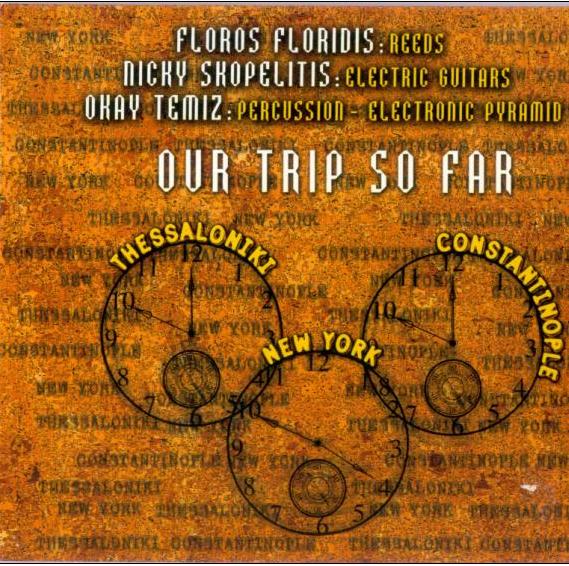
Floros Floridis, Nicky Skopelitis & Okay Temiz - Our Trip So Far (2001)

Just dredged this recording off an old collection of mp3 files and what a nice recording it is. I have long been fond of mixing a little East and West in my jazz and this hits the spot. Hard to classify (sometimes heads in an avant-garde direction) and very innovative.

"A Turk percussionist, a Greek on reeds and a Greek-American on guitars can only mean one thing: Ebullient originality. OUR TRIP SO FAR is brimming with the sounds of the East, the West, and the heart. Its uniqueness, however, doesn´t lie in its cultural diversity, it´s in the way these three instrumentalists experiment. Thus we have the traditional Greek 9/8 motif dressed in bold drums and daring reeds. Complex rhythmic patterns are thrown at the listener who´s thrown out of his seat once the guitars and sax take lead. . . Remember Coltrane´s Meditations or Davis´ Bitches Brew? Set yourself free and ´travel´—one instrument at a time. That´s the only way to get the complete jazz experience."—Maria Paravantes, Greek Beat, April 23, 2001.

Credits:
  • Floros Floridis: flute, alto sax, soprano sax, clarinette Bb, bass clarinette
  • Nicky Skopelitis: electric guitar, electric 12 string guitar
  • Okay Temiz: drums, cembe, electric berimbao, guica, electronical pyramid
Track List:
  1. Nar Cicegi (Temiz) 4:18
  2. Pitch Black (Skopelitis) 5:23
  3. The Ever Sound (Floridis, Skopelitis, Temiz) 2:51
  4. Happy Elephant (Floridis) 8:29
  5. Stars (Floridis, Skopelitis, Temiz) 2:00
  6. Kulla Baba (Temiz) 3:48
  7. Night Falls (Floridis, Skopelitis) 6:11
  8. Greetings From Overseas (Floridis, Skopelitis, Temiz) 3:48
  9. The Light Blue Above (Skopelitis) 7:57
  10. Gringos (Floridis, Skopelitis, Temiz) 3:57
Download Link: Enjoy the Music!, or Here.