Search This Blog

Showing posts with label Howard Hanson. Show all posts

Sunday, April 25, 2010

Hanson and Barber - Symphonies (1954)

Liner Notes:

It was in 1930 that Howard Hanson (b. Wahoo, Nebraska, 1896) composed his Romantic Symphony (Symphony No. 2), a score which remains after 25 years the oldest symphony by an American composer still in the active concert repertoire. For all his immense activity as Director of the Eastman School of Music (since 1924), as founder-conductor of the American Composers' Concerts and American Music Festivals held at the Eastman School since 1925, and as guest conductor in heavy demand by symphony orchestras throughout the country, Dr. Hanson has not only continued his own creative work, but he has, achieved since the 1940's a singular distinctiveness, eloquence and refinement in his musical utterance.

With the Fourth Symphony (Requiem) (Mercury MG50077), the Serenade for Flute, Harp and Strings, the Pastorale for Oboe and Strings (both on Mercury MG50076) and the two major works offered on this disc, it can be said that the very cream of Howard Hanson's mature composition is to be had on Mercury Living Presence recordings.

The traditional materials of music as handed down from the classic and romantic symphonic masters, a keen awareness of Scandinavian heritage from his Swedish parents, childhood memories of the chorales heard at the Swedish Lutheran Church during his Nebraska boyhood, a passionate and vital nature of his own—these are the elements which have gone into the making of Howard Hanson's musical language. Experience, maturity and the passage of time have seen the untrammelled "nordicism" of the choral-orchestral Lament for Beowulf (1925) and the lyrical heroics of the Romantic Symphony (1930) become transmuted into a music more refined and at the same time more intense and truly personal, beginning with the Fourth Symphony (1943) and continuing through the intimate Serenade (1946) and Pastorale (1949), as well as the larger-scaled and more brilliant Cherubic Hymn (1949), Chorale and Alleluia for Band (1953) (recorded on Mercury MG50084, and Sinfonia Sacra. A particular musical "trademark" common to all these later scores from Howard Hanson's pen is his superbly effective use of passing dissonance as an element of contrast in prevailingly diatonic and modal harmonic texture. Characteristic also is the element of brevity in terms of actual performance time and concision in the use of thematic material.

Completed on August 8, 1594, Howard Hanson's Sinfonia Sacra is so titled because of its inspiration by the story of the Resurrection as recounted in the Gospel according to St. John. On the occasion of its world premiere by the Philadelphia Orchestra early in 1955, Eugene Ormandy conducting, Dr. Hanson wrote: "The Sinfonia Sacra does not attempt programmatically to tell the story of the first Easter, but does attempt to invoke some of the atmosphere of tragedy and triumph, mysticism and affirmation of this story which is the essential symbol of the Christian faith. . . . The Sinfonia Sacra follows three other works, all concerned with the same general theme: my Fourth or 'Requiem' Symphony, and two choral works, The Cherubic Hymn and How Excellent Thy Name." The music falls into three broad divisions played as a single uninterrupted movement. There is a foreboding and suspenseful Introduction, itself in three sections. There follows a division in which three sharply defined themes are set forth—an intense and declamatory Theme 1, a calm but sustained Gregorian-style melody for strings as Theme 2, and a Pastorale of distinctly Scandinavian flavor introduced by English horn as Theme 3. The development of this last leads to the third main division of the Sinfonia Sacra, wherein we hear a climactic return of the declamatory Theme 1, the introduction and development of a new and highly agitated Theme 4, then a catharsis which finds eloquent expression in a chorale treatment of Theme 2. The music ends with a brief and utterly serene codetta scored for woodwinds and muted strings.

Howard Hanson's setting of The Cherubic Hymn was composed in 1949 and dedicated to his mother. Its text forms part of the Liturgy of St. John Chrysostom (d. 407), a basis of much of the ritual of the Eastern Orthodox Church of Greece, Russia and old Byzantium. The atmosphere of mystery and exaltation so characteristic of the Byzantine rite has inspired a number of other colorful and impressive musical works, among them Rimsky-Korsakov's Russian Easter Overture (Mercury MG50028 or MG50039) and Gustav Hoist's The Hymn of Jesus.

The text used by Dr. Hanson as translated by Stephen A. Hurlbut reads thus:

It is meet and right to hymn Thee, to bless Thee, to praise Thee, to give thanks unto Thee and to worship Thee in all places of Thy dominion- For Thy: God ineffable, inconceivable, incomprehensible, eternally existing and eternally the same, Thou and Thine only begotten Son and Thy Holy Spirit. For Thou out of nothingness didst call us into being, and when we had fallen away Thou didst raise us up again, and didst not cease doing all things for us until Thou broughtest us up to heaven, and didst bestow upon us Thy kingdom which is to come. For all these things we give thanks to Thee and to Thine only begotten Son and Thy Holy Spirit, for all Thy benefits known, for all unknown, for Thine open and secret favors bestowed upon us. And we tender thanks unto Thee for this ministry of worship which Thou hast vouchsafed to accept at our hand, although there stand before Thee thousands of archangels and ten thousands of angels, the Cherubim and the six-winged Seraphim full of eyes, soaring aloft on their wings, singing the triumphal hymn, crying, calling aloud, and saying:

     Holy, Holy, Holy,
     Heav'n and earth are full of Thy glory.
     Hosanna.

Samuel Barber (b. West Chester, Pa., 1910) has with his choral-orchestra Prayers of Kierkegaard composed in 1954 carried to new heights the fulfillment of that immense creative promise shown in his setting of Matthew Arnold's Dover Beach and in his Overture to The School for Scandal (recorded on Mercury MG50075) which marked his graduation from the Curtis Institute of Music back in 1931. The First Symphony (1936) recorded here, together with the Adagio for Strings (1936) and Essay for Orchestra (1937) (also recorded on Mercury MG50075) comprise the very peak of Barber's first youthful creative -surge; and as such these have been the foundation stone of his worldwide fame as a true master among American composers. The lyrical and polyphonic achieve a remarkable synthesis throughout the whole of Barber's output, whether in terms of writing for solo voice and orchestra as in Knoxville: Summer of 1915; in terms of a rigorously intellectual chamber piece like the Capricorn Concerto; or the impassioned dramatics of the Symphony No. 1.

It was during the winter of 1935-36 that Barber composed his First Symphony and it was given its premiere in Rome under the direction of Bernardino Molinari with the Augusteo Orchestra. In 1937 Artur Rodzinski conducted the American premiere with The Cleveland Orchestra, then conducted the work again at Salzburg that summer. In 1942, during which period he had composed his Second Essay for Orchestra, Barber re-wrote the "scherzo" section of his First Symphony, and the revised version was heard for the first time on February 18, 1944 with Bruno Walter conducting the New York Philharmonic-Symphony Orchestra. It is the revised version which is recorded here.

Barber's own analysis is clear, concise and complete: "The form," he observes, "is a synthetic treatment of the four-movement classical symphony. It is based on three themes of the initial Allegro non troppo, which retain throughout the work their fundamental character. The Allegro opens with the usual exposition of a main theme, a more lyrical second theme, and a closing theme. After a brief development of the three themes. instead of the customary recapitulation, the first theme, in diminution, forms the basis of the scherzo section (Vivace). The second theme (oboe over muted strings) then appears in augmentation, in an extended Andante tranquillo. An intense crescendo introduces the finale, which is a short passacaglia based on the first theme (introduced by violoncelli and contrabassi), over which, together with figures from other themes, the closing theme is -coven, thus serving as a recapitulation for the entire symphony."

HI-FI FACTS

The music on this disc was recorded with a single Telefunken microphone hung in the Eastman Theater adjacent to the Eastman School of Music in Rochester, N. Y. The Cherubic Hymn by Howard Hanson was recorded during May of 1953, while the symphonies by Dr. Hanson and Samuel Barber were taped one year later.

For this Mercury Living Presence recording of mixed chorus with orchestra, a single microphone was used, as in the case of the purely orchestral works here, with the position of the orchestra being only slightly altered to accommodate the nearly 200 voices of the Eastman School of Music Chorus. Those who listen to this disc will be able to judge for themselves how successfully Mercury's Living Presence recording technique has captured the massive sonorities of full chorus and orchestra in The Cherubic Hymn and the complex polyphonic textures of Samuel Barber's First Symphony.


 Credits: Eastman-Rochester Symphony Orchestra and Eastman School of Music Chorus conducted by Howard Hanson.
Tracks:
  1. Symphony No. 5 (Sinfonia Sacra)
  2. The Cherubic Hymn
  3. Symphony No. 1 in One Movement, Op. 9
Download Link: Enjoy the Music!
psswd: nessessary.net

Other Recordings of these Works:

Saturday, April 17, 2010

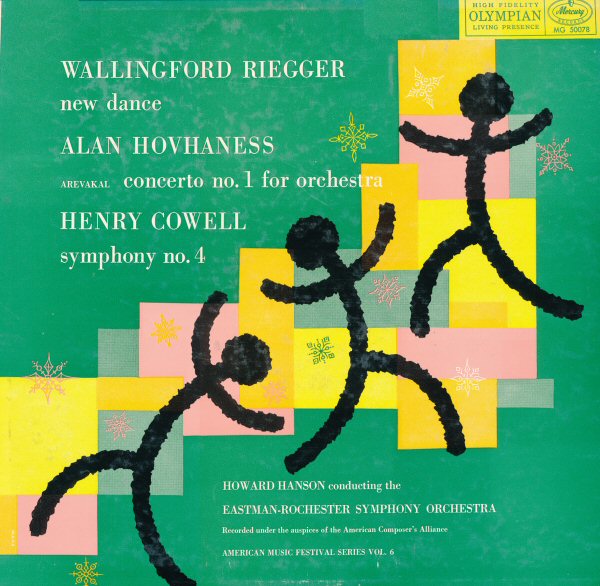
Riegger: New Dance; Hovhaness: Concerto No. 1 for Orchestra; Cowell: Symphony No. 4 (1952?)

Liner Notes:

WITH this selection of 20th century American music, recorded with the generous cooperation of the American Composers Alliance, the Mercury Classics catalog is enriched with three works which together take their inspiration from song and dance—the song and dance of the southern mountains of the United States (Cowell), of the Near East and medieval times (Hovhaness) and of Latin-America (Riegger).

WALLINGFORD RIEGGER (1885-1961) is one of the most powerful personalities of 20th century American music; but only in the late 1940's did he begin to attain the degree of public recognition warranted by the merit of such works as the Third Symphony, Dichotomy, Study in Sonority, Music for Brass Choir and the cantata In Certainty of Song.

Born in Albany, Georgia, Riegger was trained at the Institute of Musical Art in New York and at the Hochschule für Musik in Berlin. It was as 'cellist and conductor that he first pursued his musical career. Only in his 35th year did Riegger undertake a serious creative work, this being a Trio for piano, violin and 'cello, which won the Paderewski Prize for musical composition. While his early works were cast in conservative academic style, it was in 1928 with his excitingly original Study in Sonority for Ten Violins that Riegger embarked on new and radically modern paths. Making use in his own highly personal fashion of the Schoenbergian 12-tone method of composition, Riegger has evolved a musical language of extraordinary dynamism and power that could not by any stretch of the imagination be confused with the Viennese style of 12-tone writing.

As a matter of fact, Riegger's musical personality possesses three seemingly divergent modes of expression. Most personal and powerful is the pan-tonal, strong-lined and propulsively rhythmed style represented by the Third Symphony. Then there is a series of conservatively written but highly effective pieces such as the Passacaglia and Fugue and the Canon and Fugue for Strings. Thirdly, we have a whole group of scores (of which New Dance is one) composed for modern dance groups including those of Martha Graham, Hanya Holm, Doris Humphrey and Anna Sokoloff, in which the element of rhythm assumes primacy.

New Dance as recorded here is a full orchestra setting of the finale from the dance composition of that name written in 1935 for the Humphrey-Weidman Dance Group. The original score was for piano four-hands and percussion. Of Riegger's dance scores of this period, it was observed that, "For the first time in modern dance, the music had meaning and musical worth." Fritz Reiner and the Pittsburgh Symphony Orchestra gave the first performances of New Dance in its orchestral version. New Dance is, in essence, a study in cumulative rhythmic and dynamic impact, based throughout on a single pattern that might be called a synthesis of rhumba and conga.

ALAN HOVHANESS (1911-2000) is one of the most interesting, and sometimes baffling, personalities on the present-day scene of American creative music. Born in Somerville, Massachusetts, of Armenian and Scottish parentage, Hovhaness composed music virtually from his childhood years. He underwent systematic studies at the New England Conservatory of Music, as well as at the Berkshire Music Center under Bohuslav Martinü.

His early compositions were strongly influenced by the idiom of Sibelius; but when he became organist at Boston's Armenian Church and there heard old chants and songs founded on the traditions of his paternal ancestors, Hovhaness decided that there lay the road toward a musical language through which he could be true to himself.

Despite the fact that he has destroyed practically all the music he had written prior to 1940, including a pair of symphonies, Hovhaness has composed nearly 100 works since then—all of them based on his personal interpretation of the spirit of Armenian liturgical and dance music. It should be stressed that Hovhaness has not attempted either musical archeology nor folklorism, but has sought rather to evoke the simplicity, fervor and fascinating harmonic and rhythmic textures of the ancient chants. As tools for this task, he has drawn not just on the idiom of the old melodies as they exist today, but has employed modern rhythmic and contrapuntal procedures hand-in-hand with devices found in medieval troubadour and church music. Thus it is that we find in Hovhaness's music what may seem to be an odd agglomeration of Gregorian modalism, modern polytonality and polyrhythm, Landino cadences in the 14th century manner, and continually repeated ostinato figurations. The orchestral scoring, while full of color, is strangely chaste in much the manner of a Byzantine mosaic or religious icon. Among the most successful of Hovhaness's compositions have been the Thirtieth Ode of Solomon, the St. Vartan Symphony and the Concerto Arevakal recorded on this disc.

Arevakal is the name by which the Lenten season is designated in the Armenian Church and means literally, "the coming of the sun." The music of Hovhaness's Concerto for Orchestra thusly titled was composed for the Little Orchestra Society, which gave the work its world premiere under the direction of Thomas Scherman in New York on February 18, 1952. Completed on July 9, 1951, Arevakal, is dedicated to the turn-of-the-century spiritualist, "Andrew Jackson Davis, Seer of Poughkeepsie." Although the Arevakal Concerto is meant to be listened to on its own terms as music, it is also quite plain that its six movements are intended to evoke some element of mystic ritual.

The first movement, Allegretto, is subtitled Incantation and is suggestive of a ritual chant in which solo horn, oboe and clarinet play leading roles. There follows a Canzona marked Andante espressivo, in which a hymn-like melody pursues its course concluding with an epilogue scored for just a single trumpet and two French horns. The dance element takes over in the third movement which bears the medieval designation of Estampie. Polytonal and canonic textures dominate here, contrast being provided by a middle episode featuring a solo flute cadenza played against a polytonal ostinato figure in the harp. Another dance movement follows, also in polytonal-canonic texture; titled Bar, after the medieval German verse pattern (A-A-B—two Stollen followed by the Abgesang). The fifth movement is an impressive piece in slow tempo called Sharagan, or hymn of praise. The middle section contains a number of the Landino cadences which sound so strange to modern ears. Arevakal concludes with a final hymnlike movement styled Ballata, apparently with reference to the 14th century Italian verse structure cultivated by Francesco Landino (c. 1325.1397) whose basic pattern can be outlined as A-B-B-A-A.

HENRY COWELL (1911-1965) is one of the most bewilderingly prolific of American composers, his catalog numbering well over 100 works in all forms, including eight symphonies. Likewise, Cowell's musical style is sometimes equally bewildering because of the violent contrast between such unconventional piano works as The Banshee and Sinister Resonance (recorded on Circle L51-101) and apparently naively folkloristic scores like Tales of Our Countryside for piano and orchestra. The answer would seem to be that Cowell's interests have for many years. been divided between research in new methods of sound production (ranging from the use of piano tone clusters played with the first and forearm to that of various electronic devices) and exploration of musical folklore the world over. Cowell possesses also a healthy awareness of his own Celtic ancestry which finds its way into many of his works including the Fourth Symphony recorded here.

The Fourth Symphony was composed in 1946 and was first performed on October 24, 1947 by the Boston Symphony Orchestra, Richard Burgin conducting. A prefatory note in the score (published by Associated Music Publishers, New York City) sets forth Cowell's aesthetic aims and describes the music as follows:

"The intensity of tone and dignified simplicity of Henry Cowell's Short Symphony marks its folk music heritage. Since 1941 Cowell has been engaged in the composition of a series of works which are a modern development from the style of certain American 'primitive' composers at the end of the eighteenth century. This music did many things forbidden to nineteenth century harmony, but sounds superbly for voice or orchestra.

"The first movement of the Short Symphony presents without preliminary the melodic material on which the entire composition is based. The movement consists of three contrasting hymn-like tunes. The first is in chorale or psalm-tune style, with variations; next comes a flowing andante melody, and last an energetic modal melody more strictly in the shaped-note hymn tradition than the first two. Each of these is repeated, with extended melodic development.

"Adhering to symphonic convention, the next two movements are in song form and in dance form. The second movement is built on a melody of the unaccompanied narrative ballad character, set in a tonal atmosphere suggestive of a backwoods landscape rather than a literal instrumental accompaniment. The dance movement, an elaborately developed jig melody, has a strong Irish flavor which gives a striking family resemblance to the tunes played for square dancing or for solo jig competitions among loggers from Maine to Washington across the northern United States. This is a type of tune that turns up frequently in the compositions of Henry Cowell; due perhaps to his Irish parentage, it is a kind of lively music that appeals to him particularly.

"The last movement consists of an introduction, a fuguing tune and coda. The fullest development of the thematic material has been reserved for this movement. The fuguing tune is in the famous William Billings style, with the addition of occasional dissonant notes, retaining, however, the plainness of form and the polyphonic vigor of the style."

NOTES BY D. H.

Track List & Credits:

WALLINGFORD RIEGGER
  1. New Dance
ALAN HOVHANESS

Concerto No. 1 for Orchestra ("AREVAKAL")
  1. I Allegretto
  2. II Canzona
  3. III Estampie
  4. IV Allegro Vivace
  5. V Hymn
  6. VI Ballata
HENRY COWELL

 Symphony No. 4 (SHORT SYMPHONY)
  1. I Hymn, Allegro
  2. II Ballad: Andante
  3. III Dance: Vivace
  4. IV Fuguing Tune: Moderato con moto
HOWARD HANSON conducting the EASTMAN-ROCHESTER SYMPHONY ORCHESTRA

 Download Link: Enjoy the Music!