Search This Blog

Showing posts with label Alan Hovhaness. Show all posts

Sunday, May 2, 2010

Alan Hovhaness - Symphony No. 47, "Walla Walla, land of Many Waters"

I was going to Walla Walla College when the Walla Walla Symphony commissioned this work. I was also present for the world premiere performance. I scraped together some of my meager funds at the time and bought a copy of the LP, and now I have finally digitized it. It was never released on CD.

Liner Notes:

Symphony No. 47 ("Walla Walla") by Alan Hovhaness is the culmination of several years of planning and work. The story begins in December 1979 when the Walla Walla Symphony performed Hovhaness's And God Created Great Whales. An invitation was extended to the composer to come to Walla Walla for the performance, which he accepted. During his visit the idea of a symphony commemorating the Walla Walla Symphony's Diamond Jubilee was first suggested and discussed by Bertram Hoare, president of the Walla Walla Symphony at that time. After the work was officially commissioned, Hovhaness was invited to visit the area again in order to become better acquainted with the valley. When he and his wife returned in August 1980, they visited Whitman Mission, observed the wheat harvest, and talked with local residents. According to his practice, the composer carried his music notebook with him at all times, jotting down the melodic ideas which continually surface in his mind. He also discussed the orchestra with its conductor, Lee Friese.

The four-movement symphony is one of Hovhaness's longer works. “I wanted to do something big," he said, "because it's an anniversary and because it's close to where I live." Hovhaness conceived the work as a fusion of several large-scale forms. He describes it thus: "This symphony is one of my kind of symphonies—a combination of symphony and opera with many melodies, also development sections of strict canons and fugues, thus combining symphony, opera, and oratorio into one creation."

From the preceding statement it is hardly surprising that the most prominent feature of the symphony is its abundant melodies. Hovhaness explains: "I've always believed in melody, even if it isn't fashionable, I think it fills a need." Another aspect of the music to which the composer alludes is his use of counterpoint. The first and third movements begin with contrapuntal passages (canon and motet), and the finale contains two canons and a fugue. A third aspect of the work is the way Hovhaness sets off various instruments and sections of the orchestra. The strings are used alone in several passages, the brass in others, and even the percussion section has its own solo passages in the fourth movement. Various woodwind instruments are also featured in solos, particularly the English horn.

The first movement, "Journey to Walla Walla," opens with a canon for the brass instruments of the orchestra. As the canon subsides, a solo flute with harp and horn accompaniment presents music suggesting a summer journey. Menacing sounds in the percussion introduce the central portion of the movement, a "dark and wild" representation of the volcanic cloud from the eruption of Mount St. Helens in August 1980. Near the end of the movement, the reappearance of the flute melody marks the return of the peace and brightness of a summer day.

The second movement, "Land of Many Waters," a cantata for high soprano voice and orchestra, includes a demanding vocal line, rising to high F which Hovhaness wrote expressly for his wife, Hinako Fujihara. The text combines words by John Muir with those of Hinako Fujihara. An English horn solo begins the mysterious first section of the movement, prefiguring the vocal line.

Land of many waters, murmuring of spirit. story of the past,
it is far away, far away,
still murmuring, still murmuring.

An interlude which suggests thunder and lightning leads to a passage in which the soprano vocalizes to a bell-like accompaniment. Then the soloist takes up a text by John Muir:

"Let the children walk with nature.
all is divine harmony."

In the final section of the movement a pastoral melody for the soprano refers to the agricultural riches of the valley.

Oh hills of golden waves, oh sunlight on wheat fields.
Dark cloud shadows wander over tall grass.
Oh hills of golden waves.

The third movement, "Love Song" features English horn, with orchestral episodes intervening. After a brief motet for three trumpets, which opens the movement, the English horn presents a nostalgic love song. The first episode is a passage for strings alone. A lament includes other woodwind instruments in addition to the English horn followed by a hymn-like episode for strings but gradually including the other members of the orchestra. Music of angels, features flutes with English horn, and the movement ends with a majestic hymn for full orchestra.

The fourth movement, a colorful finale contains an abundance of musical ideas. An opening Song of Joy in 7/4 meter for the strings is followed by a dance. The strings take up this dance melody canonically, building to a climax and then subsiding, giving way to a new melody presented by horn and bassoon. The next section of the movement begins with a passage for the percussion section alone, to which is soon added a rhythmic passage in the strings. This rhythmic idea becomes the accompaniment for a melody in the trumpet and trombone, recalling the earlier horn-bassoon theme. The remaining trumpets and trombones take up the same melody in canon. before the texture is reduced, once more leaving the percussion to play alone. The final portion of the movement begins with a "songful" fugue. The unusually long subject is first presented in the strings, but the winds gradually enter, building to a concluding hymn, again in 7/4 meter, for the full orchestra.

Program notes by Kenneth Rudolf

 Credits:
  • Walla Walla Symphony
  • R. Lee Fiese, Conductor
  • Hinako Fujihara, Coloratura Soprano
Track List:
  1. I - Fantasy - Journey to Walla Walla
  2. II - Cantata - Land of Many Waters
  3. III - Love Song
  4. IV - Finale
Download Link: Enjoy the Music!, or here.

Other recordings of works by Hovhaness:

Saturday, April 17, 2010

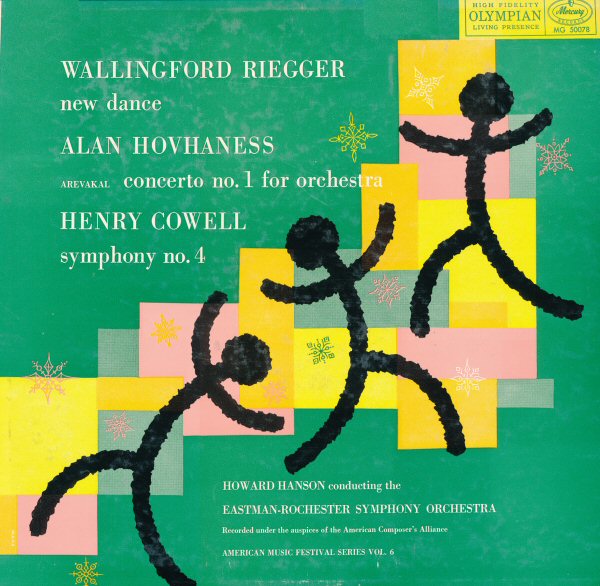
Riegger: New Dance; Hovhaness: Concerto No. 1 for Orchestra; Cowell: Symphony No. 4 (1952?)

Liner Notes:

WITH this selection of 20th century American music, recorded with the generous cooperation of the American Composers Alliance, the Mercury Classics catalog is enriched with three works which together take their inspiration from song and dance—the song and dance of the southern mountains of the United States (Cowell), of the Near East and medieval times (Hovhaness) and of Latin-America (Riegger).

WALLINGFORD RIEGGER (1885-1961) is one of the most powerful personalities of 20th century American music; but only in the late 1940's did he begin to attain the degree of public recognition warranted by the merit of such works as the Third Symphony, Dichotomy, Study in Sonority, Music for Brass Choir and the cantata In Certainty of Song.

Born in Albany, Georgia, Riegger was trained at the Institute of Musical Art in New York and at the Hochschule für Musik in Berlin. It was as 'cellist and conductor that he first pursued his musical career. Only in his 35th year did Riegger undertake a serious creative work, this being a Trio for piano, violin and 'cello, which won the Paderewski Prize for musical composition. While his early works were cast in conservative academic style, it was in 1928 with his excitingly original Study in Sonority for Ten Violins that Riegger embarked on new and radically modern paths. Making use in his own highly personal fashion of the Schoenbergian 12-tone method of composition, Riegger has evolved a musical language of extraordinary dynamism and power that could not by any stretch of the imagination be confused with the Viennese style of 12-tone writing.

As a matter of fact, Riegger's musical personality possesses three seemingly divergent modes of expression. Most personal and powerful is the pan-tonal, strong-lined and propulsively rhythmed style represented by the Third Symphony. Then there is a series of conservatively written but highly effective pieces such as the Passacaglia and Fugue and the Canon and Fugue for Strings. Thirdly, we have a whole group of scores (of which New Dance is one) composed for modern dance groups including those of Martha Graham, Hanya Holm, Doris Humphrey and Anna Sokoloff, in which the element of rhythm assumes primacy.

New Dance as recorded here is a full orchestra setting of the finale from the dance composition of that name written in 1935 for the Humphrey-Weidman Dance Group. The original score was for piano four-hands and percussion. Of Riegger's dance scores of this period, it was observed that, "For the first time in modern dance, the music had meaning and musical worth." Fritz Reiner and the Pittsburgh Symphony Orchestra gave the first performances of New Dance in its orchestral version. New Dance is, in essence, a study in cumulative rhythmic and dynamic impact, based throughout on a single pattern that might be called a synthesis of rhumba and conga.

ALAN HOVHANESS (1911-2000) is one of the most interesting, and sometimes baffling, personalities on the present-day scene of American creative music. Born in Somerville, Massachusetts, of Armenian and Scottish parentage, Hovhaness composed music virtually from his childhood years. He underwent systematic studies at the New England Conservatory of Music, as well as at the Berkshire Music Center under Bohuslav Martinü.

His early compositions were strongly influenced by the idiom of Sibelius; but when he became organist at Boston's Armenian Church and there heard old chants and songs founded on the traditions of his paternal ancestors, Hovhaness decided that there lay the road toward a musical language through which he could be true to himself.

Despite the fact that he has destroyed practically all the music he had written prior to 1940, including a pair of symphonies, Hovhaness has composed nearly 100 works since then—all of them based on his personal interpretation of the spirit of Armenian liturgical and dance music. It should be stressed that Hovhaness has not attempted either musical archeology nor folklorism, but has sought rather to evoke the simplicity, fervor and fascinating harmonic and rhythmic textures of the ancient chants. As tools for this task, he has drawn not just on the idiom of the old melodies as they exist today, but has employed modern rhythmic and contrapuntal procedures hand-in-hand with devices found in medieval troubadour and church music. Thus it is that we find in Hovhaness's music what may seem to be an odd agglomeration of Gregorian modalism, modern polytonality and polyrhythm, Landino cadences in the 14th century manner, and continually repeated ostinato figurations. The orchestral scoring, while full of color, is strangely chaste in much the manner of a Byzantine mosaic or religious icon. Among the most successful of Hovhaness's compositions have been the Thirtieth Ode of Solomon, the St. Vartan Symphony and the Concerto Arevakal recorded on this disc.

Arevakal is the name by which the Lenten season is designated in the Armenian Church and means literally, "the coming of the sun." The music of Hovhaness's Concerto for Orchestra thusly titled was composed for the Little Orchestra Society, which gave the work its world premiere under the direction of Thomas Scherman in New York on February 18, 1952. Completed on July 9, 1951, Arevakal, is dedicated to the turn-of-the-century spiritualist, "Andrew Jackson Davis, Seer of Poughkeepsie." Although the Arevakal Concerto is meant to be listened to on its own terms as music, it is also quite plain that its six movements are intended to evoke some element of mystic ritual.

The first movement, Allegretto, is subtitled Incantation and is suggestive of a ritual chant in which solo horn, oboe and clarinet play leading roles. There follows a Canzona marked Andante espressivo, in which a hymn-like melody pursues its course concluding with an epilogue scored for just a single trumpet and two French horns. The dance element takes over in the third movement which bears the medieval designation of Estampie. Polytonal and canonic textures dominate here, contrast being provided by a middle episode featuring a solo flute cadenza played against a polytonal ostinato figure in the harp. Another dance movement follows, also in polytonal-canonic texture; titled Bar, after the medieval German verse pattern (A-A-B—two Stollen followed by the Abgesang). The fifth movement is an impressive piece in slow tempo called Sharagan, or hymn of praise. The middle section contains a number of the Landino cadences which sound so strange to modern ears. Arevakal concludes with a final hymnlike movement styled Ballata, apparently with reference to the 14th century Italian verse structure cultivated by Francesco Landino (c. 1325.1397) whose basic pattern can be outlined as A-B-B-A-A.

HENRY COWELL (1911-1965) is one of the most bewilderingly prolific of American composers, his catalog numbering well over 100 works in all forms, including eight symphonies. Likewise, Cowell's musical style is sometimes equally bewildering because of the violent contrast between such unconventional piano works as The Banshee and Sinister Resonance (recorded on Circle L51-101) and apparently naively folkloristic scores like Tales of Our Countryside for piano and orchestra. The answer would seem to be that Cowell's interests have for many years. been divided between research in new methods of sound production (ranging from the use of piano tone clusters played with the first and forearm to that of various electronic devices) and exploration of musical folklore the world over. Cowell possesses also a healthy awareness of his own Celtic ancestry which finds its way into many of his works including the Fourth Symphony recorded here.

The Fourth Symphony was composed in 1946 and was first performed on October 24, 1947 by the Boston Symphony Orchestra, Richard Burgin conducting. A prefatory note in the score (published by Associated Music Publishers, New York City) sets forth Cowell's aesthetic aims and describes the music as follows:

"The intensity of tone and dignified simplicity of Henry Cowell's Short Symphony marks its folk music heritage. Since 1941 Cowell has been engaged in the composition of a series of works which are a modern development from the style of certain American 'primitive' composers at the end of the eighteenth century. This music did many things forbidden to nineteenth century harmony, but sounds superbly for voice or orchestra.

"The first movement of the Short Symphony presents without preliminary the melodic material on which the entire composition is based. The movement consists of three contrasting hymn-like tunes. The first is in chorale or psalm-tune style, with variations; next comes a flowing andante melody, and last an energetic modal melody more strictly in the shaped-note hymn tradition than the first two. Each of these is repeated, with extended melodic development.

"Adhering to symphonic convention, the next two movements are in song form and in dance form. The second movement is built on a melody of the unaccompanied narrative ballad character, set in a tonal atmosphere suggestive of a backwoods landscape rather than a literal instrumental accompaniment. The dance movement, an elaborately developed jig melody, has a strong Irish flavor which gives a striking family resemblance to the tunes played for square dancing or for solo jig competitions among loggers from Maine to Washington across the northern United States. This is a type of tune that turns up frequently in the compositions of Henry Cowell; due perhaps to his Irish parentage, it is a kind of lively music that appeals to him particularly.

"The last movement consists of an introduction, a fuguing tune and coda. The fullest development of the thematic material has been reserved for this movement. The fuguing tune is in the famous William Billings style, with the addition of occasional dissonant notes, retaining, however, the plainness of form and the polyphonic vigor of the style."

NOTES BY D. H.

Track List & Credits:

WALLINGFORD RIEGGER
  1. New Dance
ALAN HOVHANESS

Concerto No. 1 for Orchestra ("AREVAKAL")
  1. I Allegretto
  2. II Canzona
  3. III Estampie
  4. IV Allegro Vivace
  5. V Hymn
  6. VI Ballata
HENRY COWELL

 Symphony No. 4 (SHORT SYMPHONY)
  1. I Hymn, Allegro
  2. II Ballad: Andante
  3. III Dance: Vivace
  4. IV Fuguing Tune: Moderato con moto
HOWARD HANSON conducting the EASTMAN-ROCHESTER SYMPHONY ORCHESTRA

 Download Link: Enjoy the Music!